Safer: Turning Fear into Action and Crisis into Community

Safer: Turning Fear into Action and Crisis into Community Header Image

• Presented by the Bloomberg School of Public Health and Hopkins at Home
• Featuring Raj Panjabi, BSPH '06 (MPH), Dean Sarah Szanton, and Lisa Cooper •

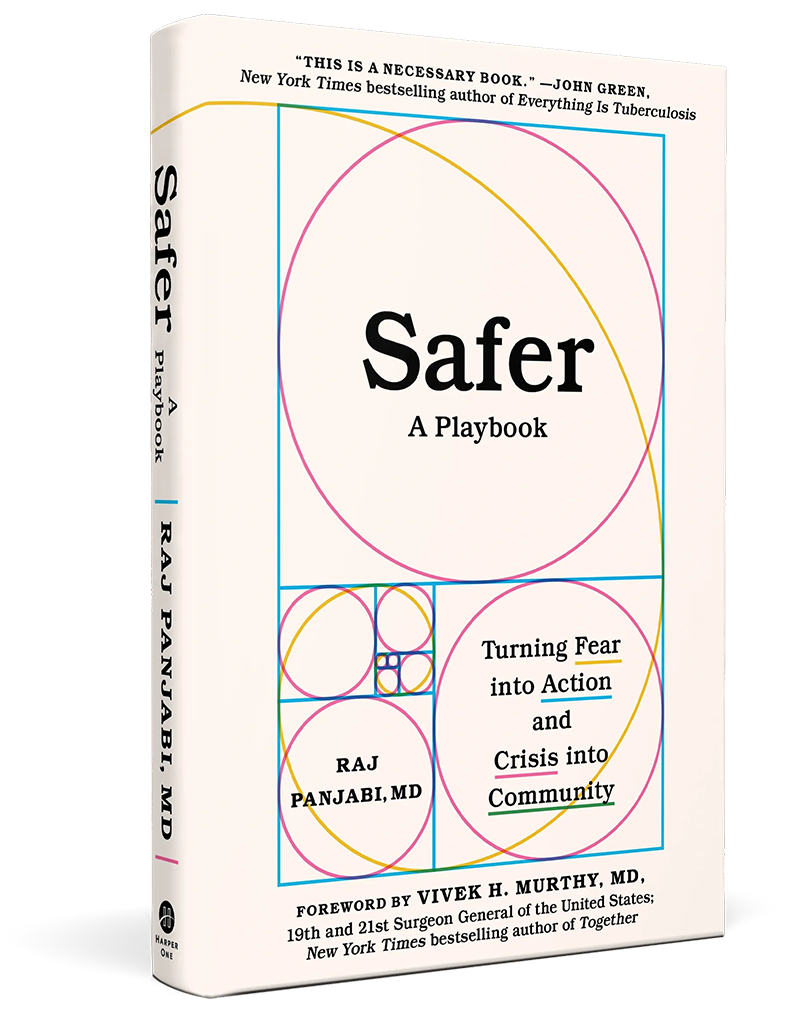
When crisis strikes — a diagnosis, a natural disaster, a sudden upheaval at work or at home — our instinct is to pull inward. But as Hopkins alumnus Dr. Raj Panjabi argues in his new book, Safer: A Playbook—Turning Fear into Action and Crisis into Community, isolation is the wrong instinct. Connection is the real protection.

Dr. Panjabi has spent his career on the front lines of crisis: fleeing civil war in Liberia as a child, building community health systems as founding CEO of Last Mile Health, and steering the nation's pandemic response as White House Senior Director for Global Health Security. In Safer, he distills that experience into a practical roadmap — eight "plays" for navigating fear, cutting through misinformation, and rebuilding trust in divided times.

Joining Dr. Panjabi for this conversation are two Johns Hopkins leaders whose own work embodies the book's central idea — that community, not isolation, is what keeps us safe. Sarah Szanton, Dean of the Johns Hopkins School of Nursing, is the architect of CAPABLE, a program that has helped thousands of older adults age safely in their own communities rather than in isolation. Lisa Cooper, the James F. Fries Professor of Medicine and a Bloomberg Distinguished Professor across Hopkins' Schools of Medicine, Nursing, and Public Health, has spent her career studying how trust between patients, physicians, and communities determines who stays healthy — and who doesn't.

Together, our speakers will explore what it really takes to turn fear into action and crisis into community, both in our health systems and in our daily lives.

For more information about Safer, including information on how to pre-order, please click here. 


Saf

Safer: A Playbook—Turning Fear into Action and Crisis into Community

The essential guide for navigating crisis and uncertainty from the acclaimed physician who led the White House response to the world’s most dangerous health emergencies.

When crisis hits — a sudden illness, a global disruption, or a career upheaval — our instinct is to retreat. Yet decades of research prove that our greatest protection isn’t isolation, it’s connection.

From high-stakes decisions in the White House Situation Room and hospital emergency room to dramatic shocks of violence and illness his family struggled with in their own living room, Dr. Raj Panjabi has navigated humanity’s most precarious moments. Now, he translates hard-earned wisdom into a step-by-step roadmap. Through gripping storytelling and cutting-edge science, Safer reveals the eight practical "plays" to protect what matters most at home and work.

ABOUT Raj Panjabi, MD, MPH (BSPH '06)
Author, "Safer: A Playbook—Turning Fear into Action and Crisis into Community"

Raj Panjabi, M.D. has spent his life preparing for the crises no one sees coming, because he has lived through them. At nine years old, he arrived in America after fleeing civil war in Liberia, an experience that forged an unshakeable conviction: no one should be left behind when the world falls apart.

Panjabi later served as White House Senior Director and Special Assistant to the President of the United States at the National Security Council, helping lead the world out of the COVID-19 pandemic and create the nation’s playbook for future public health emergencies.

Before joining the National Security Council, he led the U.S. President’s Malaria Initiative and was founding CEO of Last Mile Health, bringing care to communities beyond the reach of any health system.

Today, Panjabi is Senior Partner at Flagship Pioneering, where he helps invent and build companies using artificial intelligence and biotechnology to stop disease before it starts. He is also an associate physician and on faculty at Mass General Brigham and Harvard Medical School.

Forbes has named him one of America’s 250 greatest living immigrants celebrating the American Dream, and he has also been named one of TIME’s 100 Most Influential People in the World and one of Fortune’s 50 World’s Greatest Leaders. Panjabi lives with his wife, three children, and a legendary collection of stuffed animals.

ABOUT Sarah L. Szanton, PhD (SON '07), MSN
Dean, School of Nursing; Patricia M. Davidson Professor for Health Equity and Social Justice

Sarah L. Szanton, PhD, RN, FAAN, is Dean of the Johns Hopkins School of Nursing and the Patricia M. Davidson Health Equity and Social Justice Endowed Professor. A visionary leader and idea entrepreneur, she co-developed the nationally recognized CAPABLE program, helping older adults age safely at home, and is now pioneering Neighborhood Nursing, a bold model for universal preventive care.

Under Szanton's leadership, the school ranks No. 2 Doctor of Nursing practice programs, No. 1 nationally by U.S. News & World Report for its master's and No. 3 globally by QS World Rankings. Szanton launched the Policy Honors Program and the Institute for Policy Solutions to elevate nursing’s role in shaping health policy.  She has testified on Capitol Hill and received honors including election to the National Academy of Medicine, a Heinz Award for the Human Condition, recognition as a PBS “Next Avenue Influencer in Aging,” and being named to the 2026 Forbes 50 Over 50: Impact list.

ABOUT Lisa A. Cooper, MD, MPH (BSPH '93) 
Founding Director of the Johns Hopkins Center for Health Equity and Director of the Johns Hopkins Urban Health Institute

Dr. Lisa Cooper is the James F. Fries Professor of Medicine and a Bloomberg Distinguished Professor at the Johns Hopkins University Schools of Medicine, Nursing, and Bloomberg School of Public Health. She is also the Founding Director of the Johns Hopkins Center for Health Equity and Director of the Johns Hopkins Urban Health Institute. An internal medicine physician and pioneering public health researcher, she has studied how social and structural inequalities shape patient care, and how health systems, with communities, can improve the health of populations with health disparities.  Dr. Cooper collaborates with community and healthcare partners to implement rigorous clinical trials, identifying solutions that alleviate health disparities and translating them into practice and policy. A 2007 MacArthur Fellow and member of the National Academy of Medicine, Dr. Cooper has served as an expert advisor to several organizations, the media, and government agencies, including as a member of the President’s Council of Advisors on Science and Technology. She is the author of Why Are Health Disparities Everyone’s Problem? (Johns Hopkins University Press, 2021).

 Event Date
Monday, October 12, 2026
Start Time: 12:00pm EDT
End Time: 1:00pm EDT

 Location
Virtual Livestream

Hopkins at Home
Livestream

 Contact
Office of Alumni Relations
Joe Letourneau
Lifelong Learning
(800) JHU-JHU1
HopkinsatHome@jhu.edu

Registration Information

Ticket Type

Make a Gift

$

Payment Information